Lourdes, France is a holy site for Catholics around the world. It is where, in 1858, Our Lady appeared to a young peasant girl, Bernadette Soubirous. Since then, there have been numerous miraculous events that have taken place at Lourdes and it has become one of the most revered religious sites in the world. But what was the very first miracle at Lourdes? Let’s explore this further.
The First Miracle: Healing Water From the Grotto
It all began with a request from Our Lady to Bernadette on February 25th, 1858 - “Would you be so kind as to come here for fifteen days?” On the 15th day, Our Lady revealed her wish that a chapel should be erected on the spot where she appeared and that people should come to drink and bathe in its waters. Bernadette obeyed and soon after, miracles began to occur.
The first miracle was reported by Doctor Dozous in 1858 when he witnessed an incredible healing of his patient Catherine Latapie who had been diagnosed with bone tuberculosis and given no hope for recovery. She heard about Lourdes from her priest and decided to go there with her family. During her stay at Lourdes she drank from the spring water which ran from the grotto and afterwards experienced complete healing from her illness within three months – something which doctors considered impossible! This miracle marked the beginning of what would later be called miraculous healings at Lourdes.
To this day there have been countless cases of miraculous healing reported by visitors who made pilgrimages to Lourdes in search of cures or answers to their prayers. All these testimonies bear witness to how God performs miracles even today through Mary’s intercession at Lourdes.
The story of Catherine Latapie stands as testament to how God can perform miracles through Mary’s intercession even today at Lourdes. Her healing marks the beginning of countless other miraculous healings that have occurred here since then due to people’s faith in God and their love for Mary as our mother and advocate before him. For those seeking answers or cures for their pains, no matter how severe or incurable they may seem, know that you are welcome here at Lourdes where powerful miracles can take place through God’s grace if only we believe! May your visit bring you peace and comfort whatever your needs may be!
Lourdes water can be used both externally and internally. It is typically collected from the lourdes grotto, a site of Marian apparition in Lourdes, France. The lourdes grotto is believed by many to be a miraculous place with special healing properties.
Externally, lourdes water can be used in the same way as ordinary holy water. It can be sprinkled on statues, or onto objects that one wishes to bless or purify.
Internally, lourdes water is typically drunk from an individual container as part of a religious ritual. This is believed to aid in physical, mental and spiritual healing. Alternatively lourdes water can be used as a part of a ritual for spiritual cleansing.
It is important to note that lourdes water should never be consumed in excess, and it should only ever be used according to the instructions from your faith or religious organization. It is also vital to remember that lourdes water has no known medical benefits, and should not be taken as a substitute for medical treatment.
It is also important to note that lourdes water can only be collected from the lourdes grotto in Lourdes, France. If lourdes water is purchased online or obtained through any other means, it will not have the same spiritual and religious significance as lourdes water collected from the lourdes grotto itself.
Lourdes water is an important part of many faith traditions, and can be a powerful tool in spiritual, mental, and emotional healing. When used correctly it can be a source of comfort and strength for those who use it. It is important to remember to always use lourdes water responsibly, according to the instructions of your faith or religious organization.
Thank you for taking the time to learn about lourdes water and how it can be used in spiritual practice. We hope this information has been helpful!
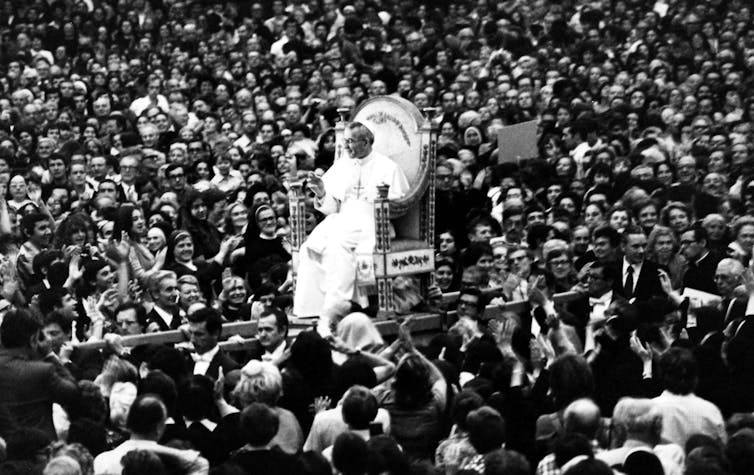
Albino Luciano, better known to the world as Pope John Paul I, reigned as pope for only 34 days before his death in September 1978. But he will soon join the ranks of 20th-century popes who the Catholic Church has canonized. This literally means they have been entered on the “canon,” or list, of people formally declared to be in heaven and have been granted the title “Blessed” or “Saint.”
The process requires a rigorous examination of the life and holiness of a candidate and involves several stages that can last years or even centuries.
After someone with a reputation for exceptional holiness dies, a bishop can open an investigation into their life. At this stage, the person can be granted the title “Servant of God.” Further details and research are needed for them to be recognized as “Venerable,” the next stage in canonization.
The following step is beatification, when someone is declared “Blessed.” This usually requires that the Vatican confirm that the person performed a “miracle” by interceding with God. Two miracles are required before a “Blessed” can be declared a saint.
What, then, is a miracle?
More than medicine
The word is used widely in nonreligious ways. However, the Catechism of the Catholic Church, which sums up the church’s teachings, defines it as “a sign or wonder such as a healing, or control of nature, which can only be attributed to divine power.”
In the canonization process, a miracle almost always refers to the spontaneous and lasting remission of a serious, life-threatening medical condition. The healing must have taken place in ways that the best-informed scientific knowledge cannot account for and follow prayers to the holy person.
Pope John Paul I’s beatification was greenlighted by the sudden healing of an 11-year-old girl in Buenos Aires who had been suffering severe acute brain inflammation, severe epilepsy and septic shock. She had been approaching what doctors considered almost-certain death in 2011 when her mother, nursing staff and a priest began praying desperately to the former pope.
The bigger picture
Catholic belief in miracles is long-standing and rooted in what the church believes about the life and work of Jesus of Nazareth. The Gospels portray Jesus as a teacher, but also as a wonder-worker who turned water into wine, walked on water and fed a large crowd with minimal food.
As a Catholic theologian and professor, I have written about saints, especially the Virgin Mary, and taught university courses on hagiography, or writing about saints’ lives. In Catholic tradition, miracles represent more than physical healing. They also confirm what Jesus preached: that God is willing to intervene in people’s lives and can take away their suffering.
For Christians, then, Jesus’ miracles suggest strongly that he is Son of God. They point to what Jesus called “the reign of God,” in which Christians hope to be reunited with God in a world restored to its original perfection.
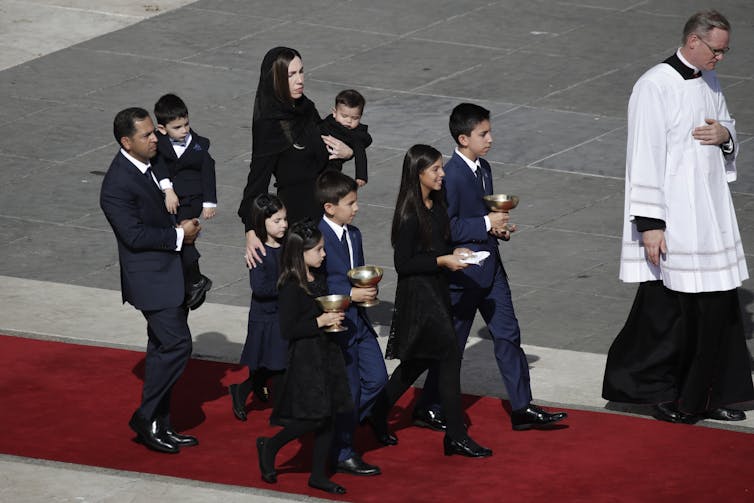
Melissa Villalobos walks with her family during a canonization Mass at the Vatican in 2019. She experienced a healing after praying to Cardinal John Henry Newman, and the Catholic Church recognized it as a miracle, clearing the way for Newman’s canonization.AP Photo/Alessandra Tarantino
Devil’s advocate?
Naturally, thoughtful people can object to the claimed supernatural origin of such events. And the development of medical science means that some healing processes can indeed now be explained purely as the work of nature, without needing to claim that divine intervention has been at work. Some Christian writers, notably the Protestant theologian Rudolf Bultmann, have also interpreted Jesus’ miracles as having a purely symbolic meaning and rejected them as being necessarily historical, literal truth.
The Catholic Church has for centuries held that science and faith are not sworn enemies but rather different ways of knowing which complement each other. That understanding guides investigations of supposed miracles, which are undertaken by the Vatican’s Congregation for the Causes of Saints, which has about two dozen staff and more than 100 clerical members and counselors.
Theologians working for the Congregation assess all aspects of the life of a candidate for canonization. These include the “Promoter of the Faith” (sometimes called “the Devil’s advocate”), whose role was changed in 1983 from finding arguments against canonization to supervising the process.
Separately, a medical board of independent scientific experts is appointed to investigate a claimed miracle. They begin by looking for purely natural explanations as they review the medical history.
New rules
The process of canonization has undergone continuous revisions throughout history.
The Catholic groups who request to open a canonization case for a particular person fund the investigation. Costs include fees paid to medical experts for their time, administrative expenses and research. But cases were often opaque and expensive, reaching well into the hundreds of thousands of dollars, Italian journalist Gianluigi Nuzzi wrote in a 2015 book.
Among Francis’ 2016 reforms was a new rule that all payments be made by traceable bank transfer so groups can better track the Vatican’s spending.
Another of Francis’ reforms is that in order for a canonization case to go forward, two-thirds of the medical board are required to affirm that the miraculous event cannot be explained by natural causes. Previously, only a simple majority was needed.
The overall point of these reforms is to protect the integrity of the canonization process and avoid mistakes or scandals that would discredit the church or mislead believers.
Since Catholics believe that the “Blesseds” and saints are in heaven and intercede before God on behalf of people who seek their help, the question of miracles is a matter of being confident that prayers can and will be heard.